
Accounting firm services are not what they used to be a few years ago. If you look closely, the biggest shift is not just digital tools it’s how Artificial Intelligence (AI) is quietly changing the way financial work gets done.
But here’s the thing most people get wrong: AI isn’t replacing accountants or advisors. It’s simply taking over the repetitive part of the job so professionals can focus on things that actually need thinking.
Let’s walk through some of the key ways AI is reshaping financial management in a way that actually helps both firms and businesses.

1. Bookkeeping That Practically Runs Itself
If you’ve ever dealt with manual bookkeeping, you know how time-consuming it can be. Sorting transactions, matching invoices, fixing small errors it all adds up.
Now, a lot of that happens automatically.
What’s changing here?
- Transactions get recorded without manual input.
- Expenses are categorized almost instantly.
- Bank data syncs in real-time.
- Reports are updated without waiting till month-end.
A simple way to understand it
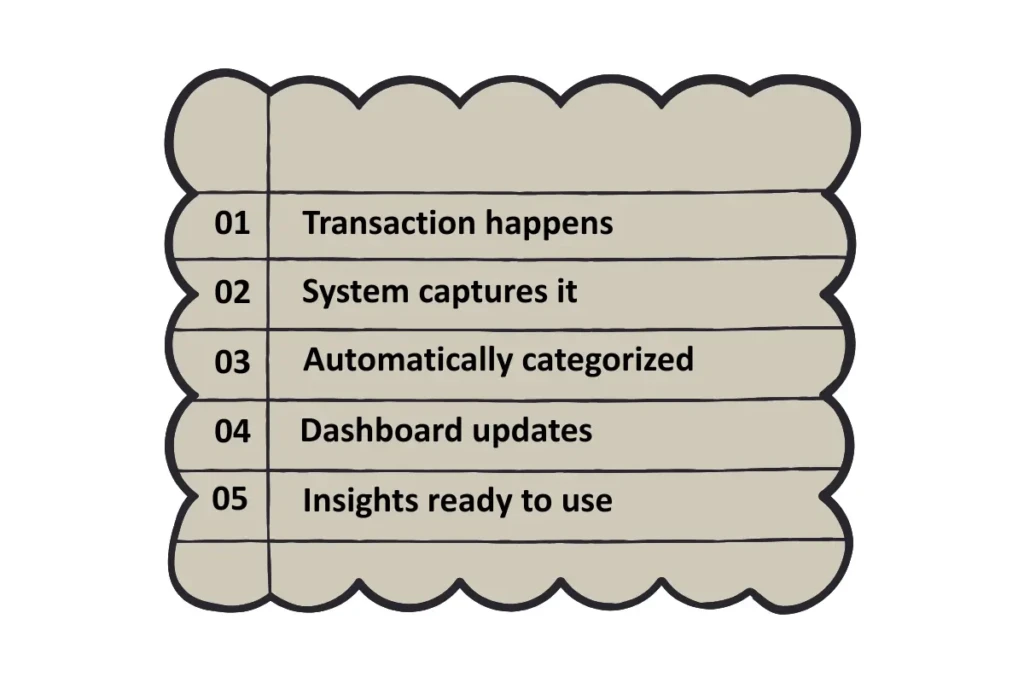
This shift is one of the reasons firms are now focusing more on advisory services in accounting instead of just managing data.
2. Financial Forecasting That Feels More Practical
Earlier, forecasting often depended on assumptions and past experience. It worked, but it wasn’t always precise.
Now, AI looks at patterns across large sets of data — something that’s difficult to do manually.
Here’s a quick comparison
| Area | Earlier Approach | Now with AI |
| Forecasting | Based on limited inputs | Based on patterns & trends |
| Speed | Takes time | Much faster |
| Insights | General | More detailed |
| Accuracy | Depends on estimation | More data-backed |
What this really means is simple: businesses get a clearer idea of where they’re heading — not just where they’ve been.
Need help implementing AI-driven accounting solutions? DGA Global can help.
3. Compliance Feels Less Stressful
Let’s be honest compliance is one of those areas that most businesses worry about. Deadlines, rules, documentation… it’s a lot to manage.
AI doesn’t remove that responsibility, but it makes things easier to track.
What improves here?
- Financial data is monitored regularly.
- Unusual activity gets flagged early.
- Compliance checks happen in the background.
- Chances of missing something reduce.
If we had to visualize priorities, it would look something like this:
Focus Areas in Modern Financial Management
- Compliance accuracy (largest focus).
- Risk detection.
- Reporting clarity.
- Process efficiency.
This is also where client advisory services become stronger, because advisors now have cleaner and more reliable data to work with.
4. Advisory Is Becoming the Real Value
This is probably the most important shift.
Earlier, accounting was mostly about reports. Today, it’s more about what those reports actually mean for the business.
With AI handling the heavy data work, professionals now spend more time on:
- Understanding business performance.
- Suggesting ways to improve profitability.
- Planning future financial strategies.
- Helping clients make better decisions.
And honestly, this is what most businesses are looking for anyway not just numbers, but clarity.
5. AI Trends: Future of Client Advisory Services in a Digital World

This is where things get interesting. Advisory services are slowly moving from “after-the-fact” guidance to something much more proactive.
A. Moving From Reaction to Prediction
Earlier, advisors would look at past data and explain what went wrong or right.
Now, things are changing:
- Potential risks can be spotted earlier.
- Decisions can be made faster.
- Businesses don’t always have to wait for reports.
It’s less about reacting and more about staying prepared.
B. Advice Is Becoming More Personal
Every business is different, and AI helps highlight those differences better.
- Insights are more tailored.
- Recommendations feel more relevant.
- Planning becomes more aligned with actual business goals.
So instead of generic advice, businesses get something that actually fits their situation.
What Businesses Actually Expect Today
If you talk to most business owners, their expectations are quite straightforward.
They usually want:
- Quick access to financial information.
- Data they can trust without double-checking everything.
- Insights that help them make decisions.
- Systems that don’t complicate their work.
Technology helps deliver this, but the real difference still comes from how professionals use it.
So, Where Is All This Heading?
AI is not taking over accounting. It’s just changing how work is divided.
Think of it this way:
- Machines handle repetition.
- Humans handle reasoning.
Firms that understand this balance are the ones that will grow faster and deliver better results.
Conclusion
There’s no doubt that AI is influencing how financial work is done today. But instead of replacing professionals, it’s helping them offer better and more efficient accounting firm services.
By reducing manual effort and improving data accuracy, AI gives professionals more time to focus on what actually matters — guiding businesses.
As financial systems become more complex and businesses continue to expand, the need for expert-led support will only increase. That’s where well-rounded accounting and tax services will continue to play a key role, especially when combined with the right use of technology.
Looking to streamline your financial operations with expert support and smart technology? Get in touch with DGA Global today and discover how our audit, accounting, and advisory services can help your business grow with confidence.
FAQs
Q1. How is AI used in accounting and finance?
AI is used to automate tasks like data entry, transaction tracking, and financial reporting. It helps analyze large amounts of data to find patterns and detect errors quickly. This allows professionals to focus more on decision-making and advisory work.
Q2. What are 5 benefits of AI?
AI improves accuracy, saves time, reduces manual errors, speeds up data processing, and provides better insights. It also helps businesses make faster and smarter decisions. Overall, it makes financial processes more efficient and reliable.
Q3. What are the four areas where AI is revolutionizing accounting?
AI is transforming bookkeeping, financial analysis, compliance monitoring, and client advisory. It automates routine tasks, improves reporting accuracy, and helps identify risks early. This allows firms to deliver faster and more valuable financial insights.