
Client advisory services are quietly changing how accounting firms build relationships. What used to be a one-time engagement like filing taxes or completing an audit is now becoming the starting point of something much bigger: long-term partnerships built on trust, insight, and consistent value.
If you look closely, the shift isn’t complicated. Clients today don’t just want work done they want someone who understands their business, helps them think ahead, and stands with them when decisions matter.
Let’s break down how this transformation actually happens.

Why Clients No Longer Settle for Just Compliance
A few years ago, most businesses were fine with basic services:
- Tax filing done on time.
- Books maintained properly.
- Reports submitted when required.
That worked… until businesses started facing faster changes, tighter competition, and more financial pressure.
Now, clients expect:
- Clear financial direction.
- Ongoing support, not just yearly interaction.
- Advice that helps them grow, not just survive.
This is exactly where advisory services in accounting start to make a real difference. They move the conversation forward from “What happened?” to “What should we do next?”
Turning a One-Time Engagement into an Ongoing Relationship
Most client relationships begin with a simple need. Maybe it’s tax filing. Maybe it’s an audit. At that stage, the interaction is limited.
But here’s what separates firms that retain clients from those that don’t:
They don’t stop after delivering the service.
What smart firms do differently:
- They explain what the numbers actually mean.
- They highlight risks the client didn’t notice.
- They suggest next steps instead of waiting for the next task.
How the journey evolves:
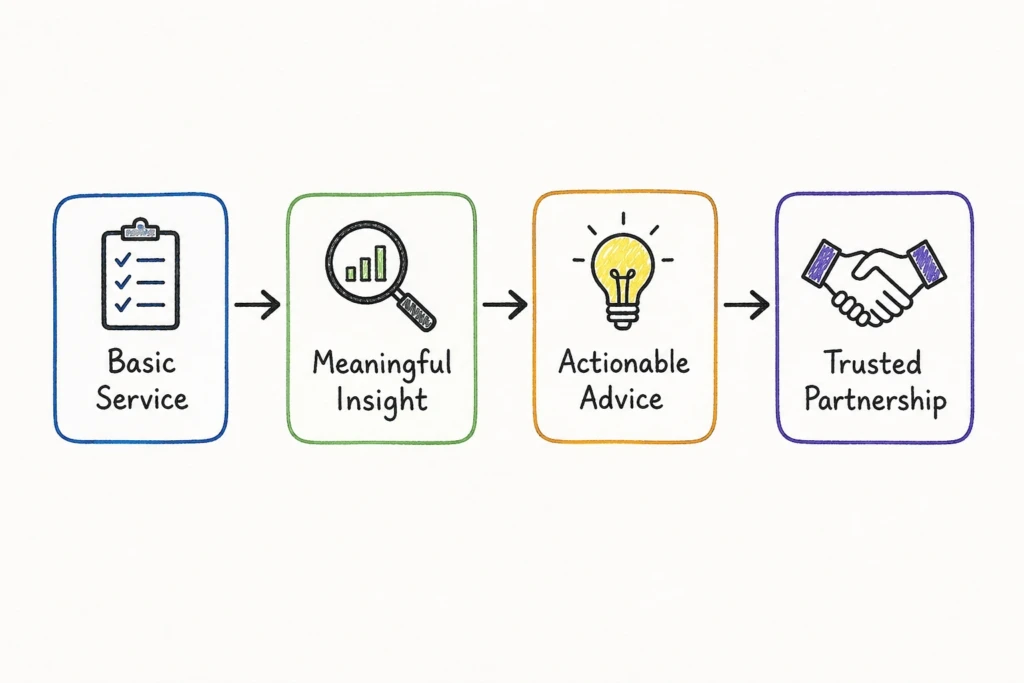
When clients start seeing that you’re thinking ahead for them, they begin to rely on you. And reliance is where loyalty begins.
Making Clients Feel Understood (Not Just Served)
There’s a big difference between doing work for a client and truly understanding them.
Clients stay longer when:
- Advice feels relevant to their industry.
- Suggestions match their current business stage.
- Conversations go beyond surface-level numbers.
What personalization looks like in practice:
- A startup gets help with budgeting and cash flow control.
- A growing business gets expansion and hiring insights.
- An established company gets risk and investment guidance.
Quick Comparison
| Area | Basic Approach | Advisory-Driven Approach |
| Reports | Past-focused | Future-focused |
| Interaction | Occasional | Continuous |
| Role of Accountant | Service provider | Strategic advisor |
| Client Experience | Standard | Tailored |
When advice starts feeling “made for them,” clients stop looking elsewhere.
Staying in Touch
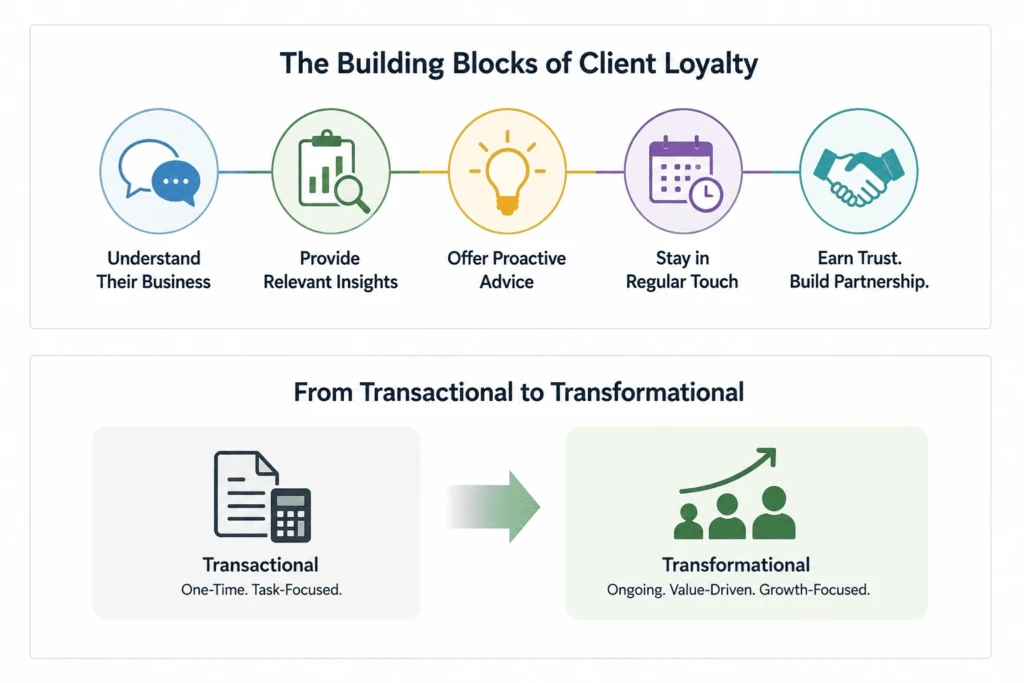
One common reason clients drift away is simple—no communication.
If the only time you reach out is when something is due, the relationship stays transactional.
But when communication becomes regular, things change.
What consistent engagement looks like:
- A quick monthly check-in call.
- Sharing insights when something unusual shows up in the numbers.
- Discussing plans before the client makes a big move.
These don’t have to be long meetings. Even small, meaningful interactions can make clients feel supported.
Over time, this builds something important: trust. And trust is what keeps clients from switching.
Delivering Value Clients Can Actually See
Clients don’t measure value by effort—they measure it by impact.
When firms combine accounting and tax services with advisory thinking, the results become visible.
Examples of real value:
- Helping a client reduce unnecessary expenses.
- Spotting a cash flow issue before it becomes a crisis.
- Suggesting better pricing strategies.
- Guiding decisions around expansion or hiring.
The mindset shift:
At first, clients ask:
“How much will this cost me?”
Later, they start asking:
“How much is this helping my business?”
That shift doesn’t happen overnight but once it does, the relationship becomes much stronger.
Mini Section: Why Do Some Clients Stay for Years While Others Leave?
It often comes down to two simple things.
1. They Feel You’re Part of Their Business
When you’re involved in decisions not just documentation you naturally become important to the client’s journey.
You’re not just preparing reports anymore.
You’re helping them avoid mistakes and move forward with confidence.
And that makes you hard to replace.
2. You Grow As They Grow
A client’s needs don’t stay the same and neither should your role.
A typical progression:
- Early stage: Help with planning and control.
- Growth stage: Help with scaling and managing complexity.
- Mature stage: Help with strategy and risk.
When your support evolves along with the client, the relationship doesn’t feel temporary it feels ongoing.
5. Using Technology Without Losing the Human Touch
Technology has made advisory easier but it’s not the main reason clients stay.
Tools can:
- Provide real-time data.
- Automate reports.
- Improve accuracy.
But what really matters is how you use that information.
Clients value:
- Clear explanations.
- Practical suggestions.
- Honest conversations.
Technology supports the process, but human insight drives the relationship.
Common Gaps That Break Client Relationships
Even capable firms lose clients when certain things are missing.
Where things go wrong:
- Work is done, but not explained.
- Communication only happens when required.
- Advice feels generic.
- Client goals are not discussed.
What works better:
- Be proactive, not reactive.
- Focus on outcomes, not just tasks.
- Make every interaction meaningful.
Small changes here can make a big difference over time.
One-Time Client vs Long-Term Partner
| Factor | One-Time Client | Long-Term Partner |
| Interaction | Occasional | Regular |
| Trust | Limited | Strong |
| Value Perception | Cost-focused | Value-focused |
| Relationship | Short-term | Ongoing |
Final Thoughts
Building long-term client relationships isn’t about adding more services—it’s about changing how those services are delivered.
When firms focus on understanding, guiding, and supporting clients consistently, the relationship naturally deepens.
Clients don’t stay because they have to.
They stay because they see the difference.
For firms looking to strengthen retention and build meaningful partnerships, adopting accounting advisory services in india is a practical and powerful step forward. It shifts the focus from completing tasks to creating impact and that’s what turns a one-time client into a loyal partner.
FAQs
Q1. How do you gain a client’s loyalty?
Client loyalty is built by understanding their needs and delivering consistent value. Regular communication and proactive advice help build trust over time. When clients feel supporteaccounting and tax services d and understood, they are more likely to stay long-term.
Q2. How does achieving the service offer contribute to keeping customers loyal?
Delivering your service as promised builds confidence and reliability. When clients see real results and clear value, they start trusting your work. This trust encourages them to continue working with you instead of looking elsewhere.
Q3. Which strategy is most effective for customer loyalty?
The most effective strategy is providing ongoing value beyond basic services. Staying in touch, offering useful insights, and being proactive makes a big difference. When clients see you as a partner, loyalty naturally follows.