
Client advisory services are rapidly becoming a core investment for businesses that want more than basic compliance and historical reporting. In today’s fast-changing business environment, leaders are no longer satisfied with knowing what happened financially they want to understand why it happened and what to do next. This growing demand for insight-driven financial support is exactly why businesses across industries are investing heavily in this service.
From startups to established enterprises, companies are turning to advisory-led firms like DGA Global to gain strategic clarity, financial confidence, and sustainable growth.

Why Are Businesses Rethinking the Role of Finance Today?
The role of finance has shifted dramatically over the last decade. Earlier, finance teams were expected to focus on bookkeeping, tax filings, and compliance. Today, businesses expect finance to actively support strategy and growth.
Businesses are rethinking finance because:
- Markets are volatile and unpredictable.
- Margins are under constant pressure.
- Decisions need to be faster and data-backed.
- Investors demand transparency and forecasting.
An advisory – driven approach places finance at the center of decision-making rather than treating it as a back-office function.
How Does Advisory-Led Finance Help Businesses Make Smarter Decisions?
One of the biggest reasons businesses invest in advisory services is decision clarity. Instead of relying on gut instinct or delayed reports, business owners get timely insights that guide actions.
- Interpret financial data in plain language.
- Understand cash flow patterns and risks.
- Forecast revenue, costs, and profitability.
- Evaluate “what-if” scenarios before major decisions.
Decision Support Through Advisory
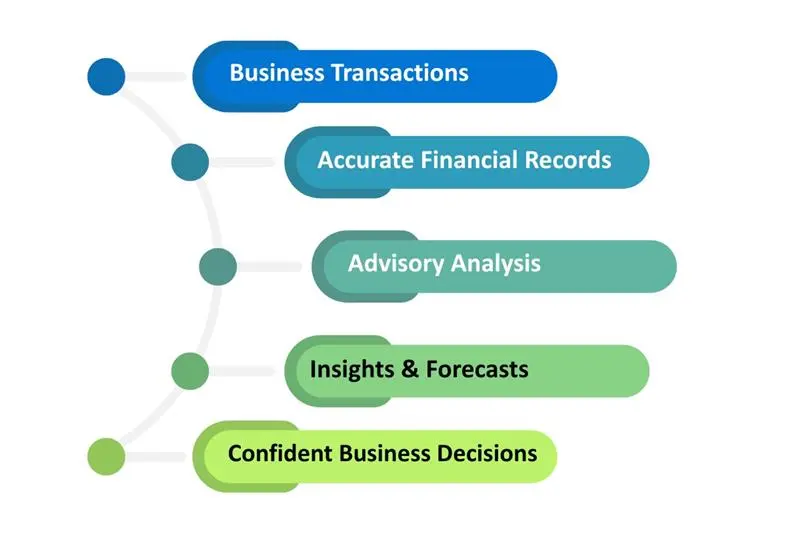
This structured approach turns numbers into meaningful guidance.
What Makes Advisory Support Different from Traditional Accounting?
Many businesses confuse advisory services with standard accounting, but the difference is significant.
Key distinction:
- Traditional accounting focuses on compliance and past data.
- Client advisory services focus on insights, planning, and future growth.
Table: Accounting vs Advisory
| Aspect | Traditional Accounting | Client Advisory Services |
| Time focus | Past | Future |
| Reports | Static | Dynamic & actionable |
| Role | Record-keeping | Strategic guidance |
| Business value | Compliance | Growth & optimization |
When combined with accounting financial advisory, businesses get both accuracy and strategic direction under one framework.
Why Are Businesses Willing to Invest More in Advisory Services?
Businesses don’t see advisory as an expense they see it as an investment. The return comes in the form of better planning, fewer financial surprises, and improved profitability.
Major value drivers include:
- Early identification of financial risks.
- Improved cost control and pricing strategies.
- Stronger budgeting and forecasting.
- Support during expansion, funding, or restructuring.
This value-driven impact explains why advisory services are gaining priority in financial budgets.
How Do Advisory Services Integrate with Audit and Accounting Functions?
Modern advisory services work best when they are integrated with audit and accounting services rather than operating separately. This integration ensures consistency, accuracy, and compliance while supporting strategic goals.
Integrated advisory helps businesses:
- Maintain audit-ready financials.
- Reduce compliance gaps and reporting errors.
- Align financial strategy with regulatory requirements.
- Improve stakeholder and investor confidence.
This holistic approach allows finance to operate as one connected system rather than disconnected functions.
Why Are Growing Businesses Replacing Traditional Accountants with Client Advisors?
As businesses scale, their financial needs become more complex. Many are now replacing transactional accounting relationships with advisory partnerships.
1. Why Do Businesses Prefer Proactive Guidance Over Reactive Reporting?
Traditional accountants usually highlight issues after reports are prepared. Client advisors, on the other hand:
- Anticipate challenges before they arise.
- Offer solutions, not just explanations.
- Act as long-term financial partners.
This proactive approach helps businesses stay ahead rather than constantly catching up.
2. How Do Client Advisors Add Industry-Level Perspective?
Client advisors work across multiple industries and business models, allowing them to:
- Benchmark performance accurately.
- Share best practices.
- Customize strategies based on industry trends.
This broader perspective is especially valuable for founders and management teams.
Who Should Invest in Client Advisory Services?
These services are not just for large corporations. They are ideal for:
- Startups planning structured growth.
- SMEs facing cash flow or margin challenges.
- Businesses preparing for audits or funding.
- Owners who want clarity without hiring a full finance team.
Any organization that wants finance to actively support growth can benefit from advisory-led engagement.
How Does Advisory Support Enable Scalable Growth?
Unplanned growth can create financial strain. Advisory services ensure that growth is supported by strong financial .foundations
Key growth-focused advisory areas:
- Cash flow forecasting and runway planning.
- Budgeting aligned with expansion goals.
- Scenario analysis for best- and worst-case outcomes.
- KPI tracking for performance management.
This ensures growth is sustainable, not risky.
Conclusion: Why Client Advisory Services Are Shaping the Future of Business Finance
The growing investment in client advisory services reflects a clear shift in business mindset. Finance is no longer just about compliance it is about clarity, control, and confident decision-making. By combining advisory insight with strong accounting and compliance frameworks, businesses gain a powerful advantage in today’s competitive market.
For companies seeking smarter financial leadership, better planning, and sustainable growth, advisory-led models deliver long-term value especially when paired with reliable accounting services for a small business.
FAQs
Q1. Why are advisory services important?
Advisory services are important because they help businesses make informed decisions using clear financial insights rather than guesswork. They provide strategic guidance, improve financial planning, and help identify risks and growth opportunities early. This allows businesses to stay competitive and grow sustainably.
Q2. What do business advisory services do?
Business advisory services analyze a company’s financial and operational data to provide practical insights and strategic recommendations. They help with planning, forecasting, performance improvement, and risk management. The goal is to support better decisions and long-term business growth.
Q3. What are the duties of a client advisor?
A client advisor reviews financial data, identifies trends, and provides strategic recommendations to support business goals. They help with forecasting, performance tracking, and risk management. Their role is to guide clients in making informed and confident decisions.