
Audit tax advisory services are going through a noticeable shift as Artificial Intelligence (AI) becomes more common in the financial world. Many business owners hear about AI tools analyzing financial data and start wondering if machines will eventually take over the work of auditors and tax advisors.
In reality, the story is not about replacement. It is about support and improvement. AI is helping professionals automate repetitive work, analyze large datasets faster, and uncover insights that may otherwise take days to identify. The real strength comes when technology and human expertise work together.
Let’s look at five important truths that explain how AI is shaping the future of auditing and advisory services.

Truth 1: AI Handles Repetitive Work So Experts Can Focus on What Matters
A large portion of accounting and auditing work traditionally involved routine processes like sorting financial records, verifying entries, or matching invoices. These tasks are essential but often time-consuming.
AI tools can now automate many of these activities.
Examples of Tasks AI Can Assist With
- Sorting and categorizing financial transactions.
- Matching invoices with payments.
- Scanning financial statements for irregularities.
- Organizing large datasets for quick analysis.
Because of this automation, professionals in Audit Firm Services are able to focus on areas that truly require experience and judgment, such as advising clients, reviewing financial risks, and improving financial strategies.
In other words, AI reduces the workload while human expertise increases the value of the service.
Truth 2: AI Helps Improve Accuracy in Financial Reviews
Accuracy has always been the foundation of financial reporting and compliance. Even a minor error can create challenges for businesses.
AI helps reduce these risks by examining financial data more thoroughly than manual processes alone.
How AI Supports Accuracy
| Financial Activity | Traditional Approach | AI-Assisted Approach |
| Transaction Checking | Manual sampling | Full dataset analysis |
| Error Identification | Manual verification | Automated anomaly detection |
| Compliance Review | Periodic checks | Continuous monitoring |
| Financial Insights | Spreadsheet-based | AI data analytics |
With AI supporting audit and accounting services, professionals can review larger volumes of information while maintaining high levels of precision.
The result is more reliable financial reporting and stronger compliance support for businesses.
Truth 3: AI Makes the Audit Process Faster and More Efficient
One of the most visible benefits of AI in finance is speed. Financial data can now be processed and organized in minutes rather than hours.
Below is a simplified flow of how AI and professionals work together in modern audits.
AI-Supported Audit Workflow
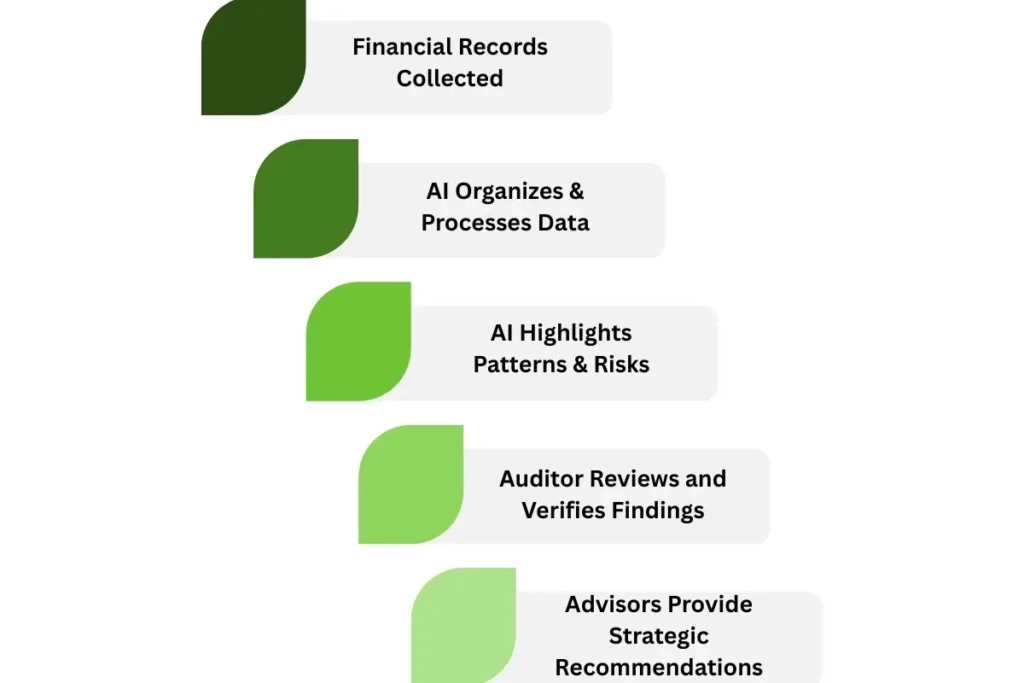
This process allows auditors to spend less time on manual review and more time helping clients understand what the numbers actually mean for their business.
Truth 4: AI Is Strengthening Global Collaboration Through Audit Offshoring
AI tools are also improving the efficiency of Audit offshoring, where global companies collaborate with specialized accounting teams in different locations.
With cloud platforms and AI-powered financial tools, teams can now work on the same datasets securely and efficiently.
Why Businesses Use Offshore Audit Support
- Access to experienced accounting professionals.
- Cost-efficient financial management.
- Faster turnaround for financial reporting.
- Better use of modern financial technologies.
AI helps make this collaboration smoother by ensuring financial information is processed quickly and shared securely, making global financial management more effective.
Truth 5: AI Helps Advisors Deliver More Valuable Insights
The biggest benefit of AI may not be automation alone. It is the extra time it gives professionals to focus on advisory work.
Instead of spending hours reviewing raw data, advisors can focus on helping clients make smarter financial decisions.
Key Areas Where Advisors Add Value
- Financial planning and forecasting.
- Tax optimization strategies.
- Risk assessment and compliance guidance.
- Business growth and investment advice.
Below is a simple representation of what clients usually expect from financial advisors.
What Clients Value Most in Advisory Services
When businesses work with financial advisors, they usually look for a balance between modern technology and professional expertise. Some of the key things clients value the most include:
- Strategic financial advice
Companies want advisors who can guide them in making better financial decisions, planning long-term growth, and improving overall financial performance. - Accurate reporting and compliance support
Businesses rely on professionals to maintain accurate financial records and ensure everything follows the latest regulatory requirements. - Risk analysis and financial insights
Identifying possible financial risks early helps organizations protect their operations and make more confident business decisions. - Use of technology for efficiency
Many organizations appreciate when advisors use advanced tools and AI-driven systems to improve efficiency, streamline processes, and deliver faster insights.
These priorities clearly show that while technology supports the process, professional expertise and trusted financial guidance remain the foundation of advisory services.
Can AI Completely Replace Financial Auditors?
This question often appears whenever new technology enters the financial industry. While AI will continue to evolve, the role of auditors and advisors will remain essential.
1. Business Context Requires Human Understanding
Financial data never exists in isolation. Numbers must be interpreted within the context of a company’s operations, industry trends, and long-term strategy.
Experienced professionals analyze not only financial reports but also management decisions, operational risks, and market conditions.
AI can highlight patterns, but understanding their impact requires human insight.
2. Trust and Professional Guidance Still Matter
Financial advisory services rely heavily on trust. Business leaders want to discuss their financial strategies with professionals who understand their goals and challenges.
Advisors help companies navigate regulations, financial planning, and growth strategies — areas where human communication and professional judgment remain crucial.
The Future of Financial Advisory: Humans and AI Working Together
Rather than replacing professionals, AI is becoming an important partner in the financial ecosystem.
In the coming years, the most successful firms will be those that combine:
- advanced financial technologies
- skilled professionals
- strategic advisory capabilities
This balance will allow firms to deliver faster insights, deeper financial analysis, and stronger business guidance.
Conclusion
AI is changing how financial professionals work, but it is not removing the need for expertise. Instead, it is helping firms deliver more efficient and insightful audit tax advisory services by automating routine processes and improving data analysis.
As businesses expand across markets and regulations become more complex, organizations will continue to rely on experienced professionals who can interpret financial information and guide strategic decisions. Along with auditing and advisory support, many companies also seek integrated financial expertise such as global valuation services to make confident investment and growth decisions.
FAQs
Q1. Can AI replace tax advisors?
AI can help with calculations, data analysis, and organizing tax information, but it cannot fully replace tax advisors. Businesses still need professionals to understand complex tax laws and give personalized advice. Human expertise is important when making strategic financial decisions.
Q2. Will auditors be replaced by AI?
Auditors are unlikely to be replaced by AI. While AI can assist in reviewing large amounts of financial data quickly, auditors are needed to interpret results and assess business risks. Their professional judgment plays a key role in the audit process.
Q3. Is AI taking over audits?
AI is not taking over audits but is helping improve how audits are done. It can automate repetitive tasks and identify unusual financial patterns. This allows auditors to focus more on analysis and providing valuable insights to businesses.