
Auditing services are often misunderstood by business owners who are not from a finance background. Some think audits are only needed when a company gets into trouble. Others believe they are only for large corporations with massive accounting teams.
But honestly, most growing businesses need audits much earlier than they realize.
Think about it this way. When your business starts growing, money starts moving faster too. More clients, more invoices, more subscriptions, more employee expenses, more vendor payments and suddenly it becomes difficult to track everything properly. Even profitable businesses sometimes struggle because nobody notices small financial gaps in time.
That is exactly where audits become useful. Not to scare business owners, but to help them understand what is really happening inside the business financially.

Audits Are Less About Numbers and More About Clarity
A lot of people assume auditing is only about checking spreadsheets. In reality, audits are more about understanding how a business operates behind the scenes.
For example, if payments are delayed every month, audits help identify why. If cash flow feels tight despite good sales, audits help uncover the reason. If records are inconsistent, audits show where the process is breaking.
That is why businesses today treat audits as a support system instead of a compliance burden.
Here are some common reasons businesses conduct audits:
- To understand financial health clearly.
- To prepare for investors or funding.
- To improve reporting accuracy.
- To reduce unnecessary spending.
- To prevent internal mistakes.
- To build long-term trust.
Everyday Business Problems Audits Often Reveal
| Situation Inside Business | What It Usually Leads To |
| Missing payment records | Cash flow confusion |
| Unclear approvals | Expense leakage |
| Delayed bookkeeping | Reporting errors |
| No financial monitoring | Decision-making problems |
| Weak internal checks | Higher financial risks |
Most businesses do not notice these problems immediately because they build slowly over time.
What Happens During an Audit? (Without the Complicated Finance Language)
One reason many owners avoid audits is because the process sounds too technical. But the actual process is fairly practical.
Auditors basically review how money is entering, leaving, and being recorded inside the business. They also check whether systems are working smoothly or not.
Simple Audit Flow
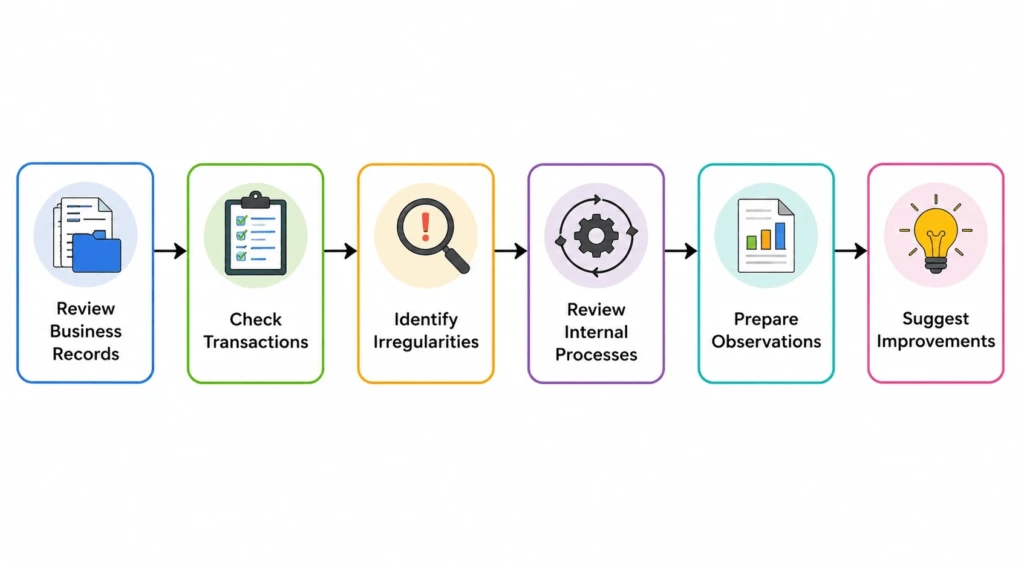
Good auditors do not simply point out mistakes. They usually recommend ways to make operations cleaner and more manageable.
Areas Usually Reviewed During Audits
| Audit Area | Why It Matters |
| Expense records | Helps control overspending |
| Revenue tracking | Improves reporting accuracy |
| Vendor payments | Prevents duplicate transactions |
| Tax records | Reduces compliance pressure |
| Approval systems | Improves accountability |
For non-finance owners, audits often provide clarity they never had before.
Audit Offshoring Mistakes That Haunt Finance Teams
Over the last few years, many companies have started exploring Audit offshoring to handle financial workloads more efficiently. It can absolutely help businesses save time and improve operational support but only when managed properly.
The problem is that some businesses jump into offshoring too quickly without building the right systems first.
Mistakes That Commonly Create Problems
Focusing Only on Cost
Some companies choose offshore teams based only on pricing. Later, they struggle with poor communication and inconsistent reporting.
No Proper Process Documentation
When workflows are unclear, offshore teams spend more time figuring things out than actually completing tasks.
Expecting Instant Perfection
Like any working relationship, offshore support also needs proper onboarding and coordination.
Ignoring Data Security
Financial information is sensitive. Businesses should always check whether offshore teams follow proper security practices.
Healthy Offshoring vs Risky Offshoring
| Healthy Audit Offshoring | Risky Audit Offshoring |
| Clear communication | Frequent misunderstandings |
| Experienced professionals | Poor-quality reporting |
| Defined systems | Unstructured workflow |
| Security-focused approach | Data handling risks |
| Long-term planning | Short-term cost mindset |
Businesses that approach offshoring carefully usually see far better long-term results.
Why Modern Audit and Accounting Services Feel Different Today
Traditional audits used to feel stressful and paperwork-heavy. Modern audit and accounting services are much more flexible now because technology has changed the way finance teams work.
Today, many businesses use:
- Cloud accounting software.
- Real-time dashboards.
- Automated expense tracking.
- Shared reporting systems.
- Digital approvals.
This makes financial visibility much easier, especially for founders who are not finance experts.
Why Businesses Invest in Audits Today
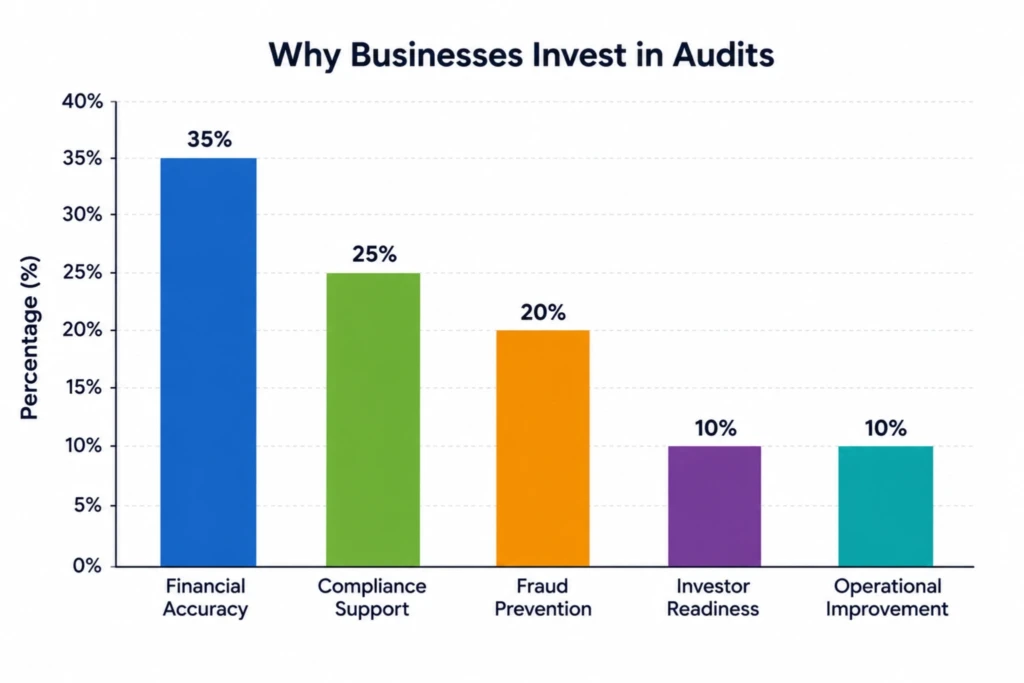
The biggest shift today is that businesses no longer see audits as just a legal task. They see them as a way to stay financially organized while growing.
Why Growing Businesses Usually Face More Financial Confusion
Ironically, businesses often experience more financial stress during growth phases.
Why?
Because operations expand faster than systems.
A small business can manage finances casually in the beginning. But once the company grows, informal processes stop working properly.
Common Growth-Stage Problems
Too Many Responsibilities on Small Teams
One employee may handle invoicing, approvals, reporting, and vendor coordination all at once.
Communication Gaps Between Teams
Finance, operations, and leadership teams sometimes work separately without sharing consistent information.
Signs Your Business Might Need an Audit
| Warning Sign | Possible Reason |
| Frequent reporting corrections | Weak financial controls |
| Delayed tax preparation | Poor documentation |
| Cash flow confusion | Untracked expenses |
| Investor concerns | Lack of transparency |
| Rapid business growth | Need for better systems |
Many businesses wait too long before fixing these issues.
Final Thoughts
For non-finance owners, audits do not have to feel overwhelming. At their core, audits simply help businesses stay financially organized and operationally stable.
The businesses that usually benefit the most from audits are not necessarily the biggest companies. They are the companies preparing for growth and trying to avoid expensive mistakes before they happen.
As more businesses expand globally, many are also exploring offshore accounting services to improve financial support, reduce internal workload, and create better reporting structures without heavily increasing operational costs.
At the end of the day, business owners make better decisions when they clearly understand their numbers and that is exactly what a good audit helps achieve.
FAQs
Q1. What is an example of a non-financial audit?
A non-financial audit checks areas other than company finances, such as cybersecurity, operational processes, employee safety, or environmental compliance. For example, a workplace safety audit ensures employees are following proper safety standards.
Q2. What are the 5 C’s of audit findings?
The 5 C’s of audit findings are Criteria, Condition, Cause, Consequence, and Corrective Action. These help explain what the issue is, why it happened, its impact, and how it can be fixed.