
Offshore accounting services sound great in theory cost savings, skilled professionals, and faster work. But when businesses actually start working with offshore teams, one concern shows up almost immediately: “What about time zone differences?”
It’s a fair question. When your team is starting the day and your offshore partner is logging off (or vice versa), things can feel a bit out of sync.
But here’s the reality most companies that stick with offshore models don’t struggle with time zones for long. In fact, many end up using it to their advantage.
Let’s look at how that works in real situations.

It’s Not a Problem It’s a Different Way of Working
At first, the time gap feels like a delay. But once workflows settle, it often turns into something useful.
Think about it this way while you’re sleeping, someone else is working on your books.
What that looks like in practice
- You share files at the end of your day.
- The offshore team works on them overnight.
- By morning, updates are ready for review.
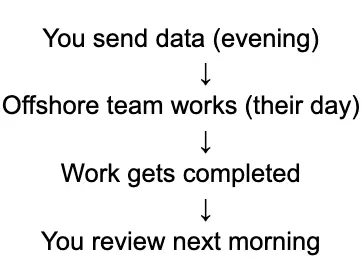
This is why many businesses prefer off shore accounting it quietly creates a 24-hour work cycle without hiring extra in-house staff.
Communication Matters More Than Time Zones
Most of the issues people blame on time zones are actually communication gaps.
If instructions are unclear, even teams in the same office can get stuck. On the other hand, clear communication can make global teams work smoothly.
What usually works well
- Keeping instructions simple and written.
- Using shared tools instead of long email threads.
- Setting fixed times (even short ones) for overlap calls.
- Avoiding last-minute task changes.
Quick Comparison
| Situation | Without Structure | With Clear Communication |
| Task Updates | Delayed replies | Visible in shared tools |
| Deadlines | Confusing | Clearly defined |
| Meetings | Random | Pre-scheduled |
| Work Flow | Stop-start | Smooth |
Many companies using Global outsourcing services realize this early once communication is fixed, time zones stop being a big issue.
Simple Processes Save a Lot of Time
One thing that helps more than anything else? Clear processes.
When everything is defined formats, timelines, responsibilities teams don’t have to wait around for instructions.
Small changes that make a big difference
- Standard report formats.
- Checklists for recurring tasks.
- Shared folders with proper naming.
- Clear “who does what” guidelines.
If we break down what really matters here, it looks something like this:
What keeps offshore work smooth
- Clear processes.
- Defined responsibilities.
- Consistent communication.
- Timely delivery.
When these are in place, work keeps moving even if both teams are not online together.
Familiar Teams Make Everything Easier
Another thing businesses often overlook is continuity.
Working with a dedicated team (instead of changing people frequently) makes coordination much easier over time.
Why this helps
- The team understands your business better.
- Fewer explanations are needed.
- Work becomes faster and more accurate.
- Trust builds naturally.
After a few months, many companies don’t even notice the time difference anymore. It just becomes part of the routine.
Can Time Zone Differences Actually Work in Your Favor?
This is something many businesses are unsure about in the beginning.
1. Faster Turnaround Without Extra Pressure
When work moves across time zones, it doesn’t stop at the end of your office hours.
- Tasks keep moving even when your team logs off.
- Deadlines feel less stressful.
- You wake up to completed work instead of pending tasks.
That’s a big advantage, especially during busy periods.
2. Better Focus for Offshore Teams
Offshore teams often work in quieter, more focused environments.
- Fewer interruptions.
- More time for deep work.
- Better attention to detail.
This often improves the overall quality of work, especially in accounting and reporting tasks.
What Businesses Should Keep in Mind
From experience, companies that succeed with offshore accounting usually keep things simple.
They focus on:
- Clear communication.
- Consistent processes.
- The right tools.
- A stable team structure.
That’s really it. No complicated strategy needed.
The Bigger Picture
Over time, the conversation around offshore accounting has changed. It’s no longer just about saving costs.
It’s about working smarter.
Time zones, which once felt like a challenge, are now part of how global businesses operate. When managed properly, they actually help improve efficiency.
Conclusion
Time zone differences can feel tricky in the beginning, but they’re not a long-term problem. With the right setup, they become part of a smooth working system.
Businesses using offshore accounting services often find that once communication and processes are in place, things run more efficiently than expected.
As companies continue to expand globally, combining offshore expertise with additional support like global valuation services can further strengthen financial planning and decision-making.
FAQs
Q1. What challenges have you faced in accounting and how did you overcome them?
One common challenge is managing large volumes of data accurately and on time. This can be handled by using better tools, clear processes, and regular checks. Good communication within the team also helps avoid errors and delays.
Q2. What is the main reason for offshore outsourcing?
The main reason is to reduce costs while still accessing skilled professionals. Businesses can also improve efficiency by getting work done faster. It allows companies to focus more on core activities instead of routine tasks.
Q3. What are the benefits of offshoring?
Offshoring helps save costs, improves productivity, and provides access to global talent. It also allows work to continue across different time zones. Overall, it helps businesses scale operations more efficiently.