
Global bookkeeping and tax solutions are no longer something only large corporations rely on. Today, even growing businesses are quietly shifting away from local accounting setups and not without reason.
If you speak to founders or finance heads who’ve scaled beyond one market, a common pattern emerges. At some point, the local accounting model starts feeling restrictive. Not because it’s wrong, but because it was never designed for how businesses operate today.
Let’s walk through this shift in a more practical, real-world way.

Why Do Businesses Start Questioning Their Local Accounting Setup?
Most businesses don’t switch immediately. It usually starts with small friction points.
You might notice things like:
- Delays in closing books at month-end.
- Confusion around handling international transactions.
- Difficulty getting clear, real-time financial insights.
At first, these seem manageable. But as operations expand, these issues begin to stack up.
The real problem isn’t the team it’s the structure. Local setups are often built for stability, not scale.
A Quick Comparison That Often Changes Perspective
| Aspect | Local Setup | Global Approach |
| Flexibility | Fixed | Adaptable |
| Expertise Range | Narrow | Broad |
| Cost Structure | Predictable but high | Optimized |
| Growth Support | Limited | Scalable |
This is usually the point where businesses start exploring alternatives.
Can a Local Team Realistically Handle Global Compliance?
This is where things get more serious.
Once a business starts working with international clients or enters new markets, compliance becomes less straightforward.
What Typically Happens?
A local team may:
- Rely heavily on external consultants for global tax matters.
- Take longer to interpret new regulations.
- Struggle with cross-border reporting formats.
None of this means they lack capability it simply means they’re working outside their natural scope.
How Global Support Changes the Equation
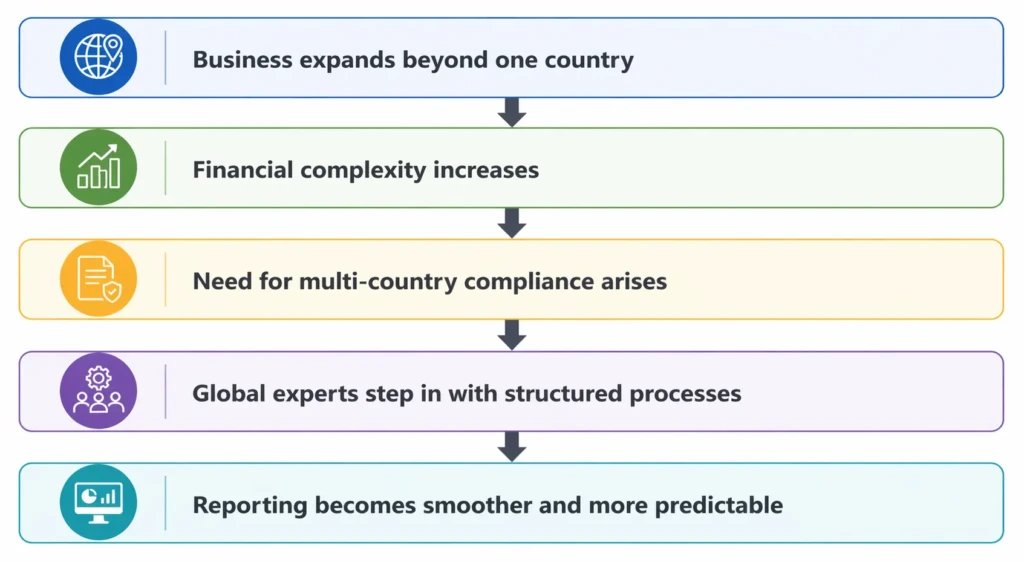
With a bookkeeping and tax service that operates globally, the process becomes less reactive and more structured.
Are You Actually Saving Money with a Local Team?
This is a tricky one. On paper, local teams often seem more affordable.
But when you look closer, the picture changes.
The Obvious Costs
- Salaries
- Office space
- Software subscriptions
The Less Obvious Ones
- Time lost due to inefficiencies
- Rework caused by errors
- Delayed insights that impact decisions
These hidden costs don’t show up in a balance sheet directly—but they affect business performance.
Where Global Models Feel Different
With book keeping and accounting services offered globally, businesses often notice:
- Faster turnaround times.
- More structured workflows.
- Fewer bottlenecks during busy periods.
It’s not just about spending less it’s about getting more value from the same function.
What Happens When Your Business Starts Growing Fast?
Growth sounds great and it is. But it also puts pressure on systems that weren’t built for it.
With a Local Setup
You may find yourself:
- Hiring in a rush
- Training new people constantly
- Dealing with inconsistent outputs
This creates operational noise right when you need clarity the most.
With a Global Setup
Things tend to feel more stable.
You Can Scale Without Hiring Stress
Teams are already in place. You simply extend the scope.
Processes Stay Consistent
Work doesn’t depend on individuals—it follows a system.
Technology Does the Heavy Lifting
Cloud tools and automation reduce manual dependency.
Growth, in this case, feels more controlled than chaotic.
What Concerns Do Businesses Usually Have?
“Will the transition be messy?”
It can be, if not handled properly. But most global providers follow a phased approach, so nothing breaks overnight.
“What about data security?”
A valid concern. But in reality, global firms often use stricter security protocols than smaller local setups.
“Will communication become difficult?”
Surprisingly, no. With structured reporting and regular updates, communication often improves.
Then Why Do Businesses Still Make the Shift?
Because once the system settles, the difference is noticeable.
Reporting becomes more predictable.
Compliance feels less stressful.
Decision-making becomes faster.
The initial hesitation usually fades once operations stabilize.
Where Does DGA Global Fit Into This?
For businesses exploring this shift, having the right partner makes all the difference.
DGA Global focuses on:
- Bringing structure into financial operations.
- Supporting cross-border compliance.
- Offering advisory along with execution.
The idea is not just to maintain records, but to make financial data more useful for decision-making.
Conclusion: Is It Time to Rethink the Way You Handle Finance?
Global bookkeeping and tax solutions are not just about outsourcing work—they’re about upgrading how financial operations function.
They bring:
- Better clarity
- More flexibility
- Systems that actually support growth
And in a business environment where speed and accuracy matter more than ever, that shift becomes hard to ignore.
For businesses looking at long-term efficiency, exploring cpa bookkeeping services to india can be a practical step not just to reduce costs, but to build a more reliable financial backbone.
FAQs
Q1. What are the benefits of using tax solutions?
Tax solutions help ensure accurate filings, reduce errors, and keep businesses compliant with changing regulations. They also save time, improve financial planning, and help identify opportunities to legally reduce tax liabilities.
Q2. What do you think is the most challenging aspect of bookkeeping and how do you manage it?
The most challenging aspect is maintaining accuracy while handling large volumes of transactions. This is managed by using structured processes, regular reconciliations, and automated tools to minimize errors and keep records up to date.
Q3. What are five types of taxes?
Five common types of taxes include income tax, corporate tax, sales tax, payroll tax, and capital gains tax.